Setting Your Freelance Florist Rates

Setting your freelance rate with confidence and clarity.
Freelancing for other florists is one of the best ways to grow your skills, stay connected in the industry, and build a flexible career doing what you love.
But when it comes to what to charge, many florists hesitate — unsure what’s “normal,” what’s fair, or how to bring up the subject at all.
The truth is: your time, experience, and talent all have value.
And while there’s no single rate that fits everyone, understanding the going standards — and learning how to confidently talk about money — helps ensure that your freelance work is both fair and sustainable for you and for the florists who hire you.
Why It’s Important to Know Your Worth
When you freelance for another florist, you’re not “just helping out.”
You’re bringing skill, creativity, reliability, and experience to someone else’s brand or project.
Setting your rate:
Reflects your professional value and skill level
Helps maintain fair standards across the industry
Ensures your freelance work is sustainable (covering your costs, time, and tax)
Supports a sense of mutual respect between florists
Remember: you’re self-employed. You have every right to set your rate, discuss it openly, and agree something that works for both you and the florist you’re supporting.
A Note on Minimum & Living Wages
Even though you are working as a self-employed freelancer (supporting another florist) — and the statutory minimum wages apply to employees rather than to freelance contractors — it’s still very useful to know the legal and industry wage baselines. These help you evaluate whether your freelance rate is at least sensible, and provide a benchmark below which you should be cautious of underselling yourself.
2025 UK Statutory Rates (for employees)
From 1 April 2025 the rates for workers (employees) in the UK are:
£12.21 per hour for those aged 21 and over (the statutory “National Living Wage”) GOV.UK+2GOV.UK+2
£10.00 per hour for those aged 18-20 GOV.UK+1
£7.55 per hour for those aged 16-17 (and apprentices under certain conditions) GOV.UK+1
Voluntary “Real Living Wage”
In addition to the statutory minimum, there is the voluntary “real living wage” benchmark set by the Living Wage Foundation (based on cost of living). For example:
UK (outside London) rate: approx £13.45 per hour (for 2025-26) Living Wage Foundation+1
London rate: approx £14.80 per hour for 2025-26 in London region Living Wage Foundation+1
These are higher than the statutory minimum, reflecting actual living-cost calculations, and although not legally required, set a good benchmark if you’re being paid fairly.
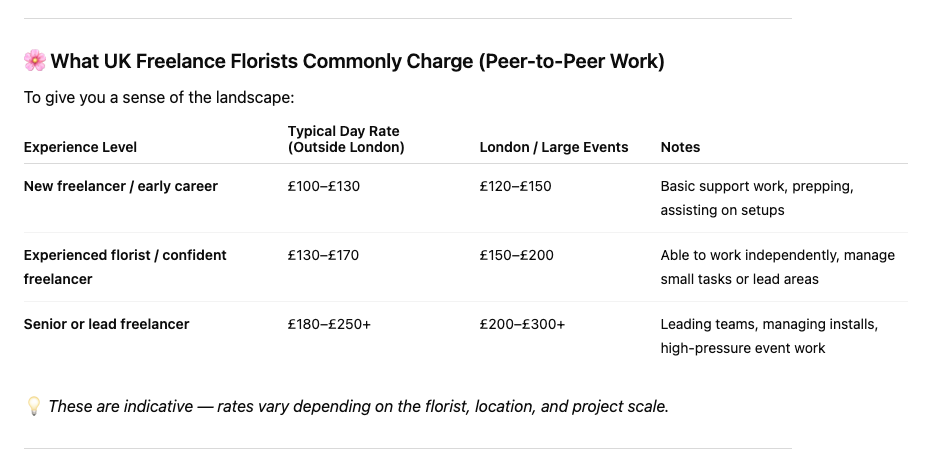
Factors to Consider When Setting Your Rate
When agreeing a rate with another florist, think beyond just the number of hours. Consider:
Your experience — how long you’ve worked, and what level of responsibility you can take on
The nature of the job — wedding setup, corporate install, or retail cover all require different energy and skill
Location — London and major cities naturally carry higher costs (and higher rates)
Travel — discuss mileage, parking, or travel time before accepting the job
Duration — longer projects might justify a slightly lower rate per day, whereas one-off or short notice jobs can be higher
Physical demand — large installs or long setups may justify a premium
Client expectations — some lead florists have larger budgets than others; communicate and find balance
Working hours — clarify start/finish times and whether the rate includes breaks
Negotiation: Finding a Rate You’re Both Happy With
This is really important.
When you freelance for another florist, you’re part of a professional relationship. Mutual respect and clear communication are key.
Here’s how to approach it:
Be transparent: Share your rate clearly, and be open to a discussion.
Listen to their budget: They may be working within a set client price.
Meet in the middle: If their rate is lower than you hoped, decide whether the opportunity, relationship, or creative project makes it worth it.
Don’t feel dictated to: You can politely decline if the rate doesn’t work for you.
Agree travel separately: Always clarify this in advance to avoid awkwardness later.
Put it in writing: A quick message or email confirming rate, hours, and location protects both parties.
Example phrasing:
“My usual freelance day rate is £140, plus travel. Does that fit within your budget for this project?”
Simple. Professional. Friendly.
Remember: You’re in Control
As a self-employed florist, you decide what you charge.
That’s one of the freedoms of freelancing, but also one of the responsibilities.
If you’re consistently in high demand, increase your rate.
If you’re building experience, accept jobs that help you grow (but don’t undersell yourself).
You can, and should, review your rates at least once a year.
Where to Stay Informed
Keep an eye on:
Living Wage Foundation — for current “real living wage” and London rates
The Botanic Business Hub — industry articles discussing current floristry rates
Job boards like Indeed to see live market rates
And of course, The Freelance Florist Members Community — where you can share insights and discuss rates with peers across the UK.
Freelancing for other florists is a brilliant way to stay creative, gain experience, and connect within the floral community.
But it should always be fair, professional, and properly paid.
Know your worth.
Be confident talking about money.
And remember, you and the florist hiring you are equals, working together to create something beautiful.